Most Xero data loss conversations focus on missing transactions. A deleted invoice, a corrupted import, a bulk contact record overwrite. These are visible problems — the data that was there is no longer there, and the gap is eventually noticed.
The chart of accounts damage works differently. When a COA structure is changed — accounts renamed, reclassified, deleted, or renumbered — the transactions do not disappear. The data is still there. What breaks is the framework that organises it. And because the damage is structural rather than transactional, it often goes undetected for weeks or months before surfacing in a report that simply does not make sense anymore.
Xero backup that captures your complete chart of accounts structure — not just transaction data — is what makes this class of damage recoverable. This article explains how COA structure changes break Xero reporting, why they are more common than most users expect, and what a complete backup strategy needs to cover.
What the Chart of Accounts Actually Does
Structure, Not Data
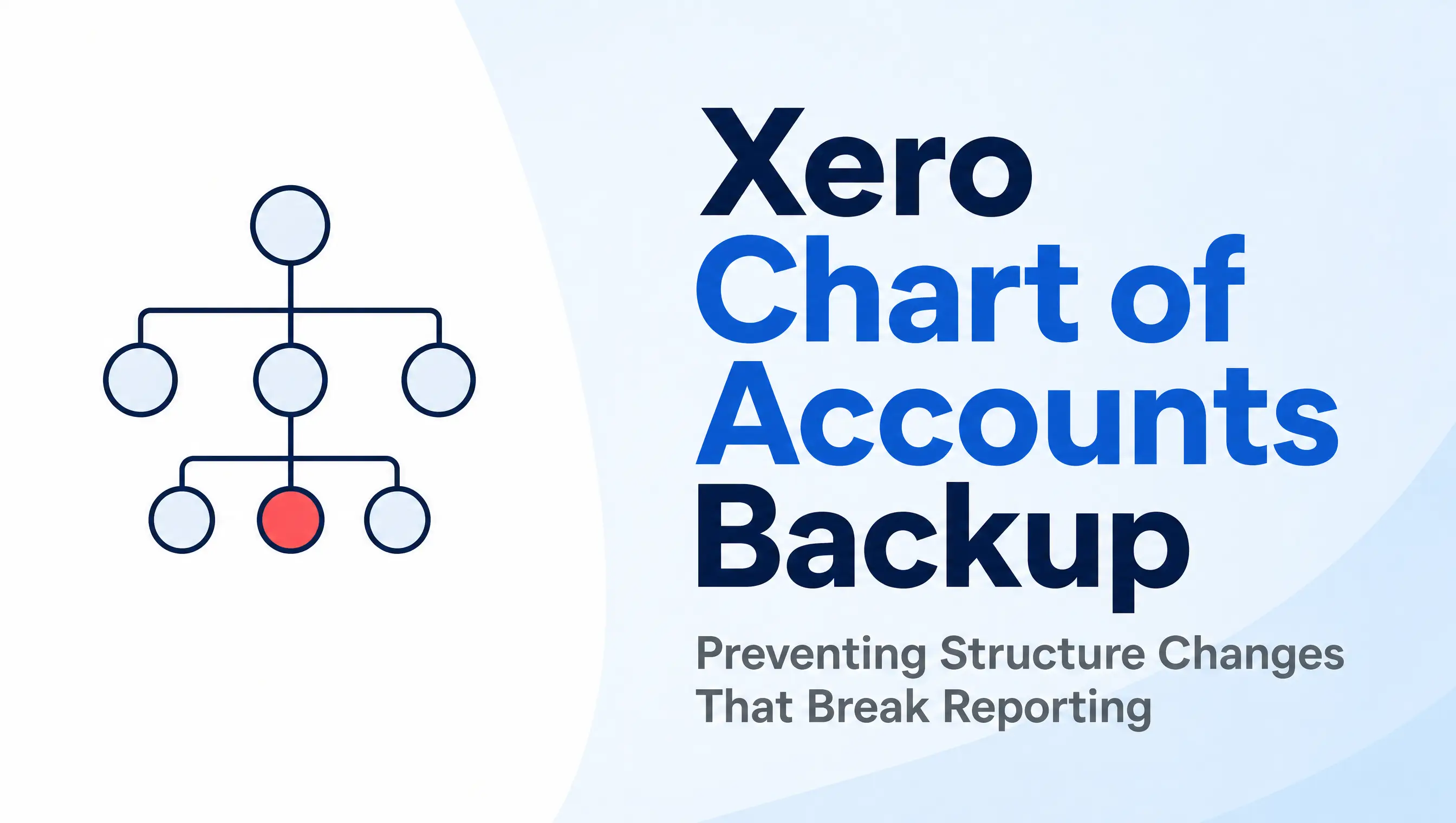
The chart of accounts is the master list of all account names, numbers, types, and categories used in a Xero Organisation. It is the structural framework that every transaction in the general ledger is mapped to — not the data itself, but the architecture that gives the data meaning.
When you run a profit and loss report, Xero pulls transactions mapped to income and expense accounts and presents them according to the current COA structure. When you run a balance sheet, it draws from asset, liability, and equity accounts. The reports depend entirely on the accuracy and consistency of that underlying structure.
This is why COA changes are different from transaction errors. A deleted supplier invoice creates a visible gap. A reclassified account silently corrupts how every historical transaction mapped to that account appears in every report going forward.
Why Xero's COA Is More Vulnerable Than Users Expect
Xero makes the chart of accounts changes accessible to any user with the right permission level. There is no approval workflow, no change log visible to all administrators, and no automatic alert when an account is renamed, reclassified, or deleted. A change that takes thirty seconds to make can affect months of historical reporting — and the person who made the change may not realise what they changed.
Common COA changes that create reporting problems include renaming an account in a way that breaks custom report filters, reclassifying an expense account as a cost of goods sold account (which shifts the gross profit margin calculation), deleting an account that still has transactions mapped to it, and restructuring tracking categories in a way that makes historical comparisons impossible.
How COA Structure Changes Break Reporting
The Reclassification Problem
Account reclassification is the most damaging COA change because it affects historical reporting retroactively. In Xero, when an account's type is changed — for example, reclassifying an operating expense account as a revenue account — every transaction previously coded to that account is now reported under the new classification. A P&L that showed a particular expense line item for the past twelve months will now show those amounts as income. The numbers do not change. Their meaning does.
For a bookkeeping practice preparing year-end accounts for a client, discovering that a reclassification has silently distorted twelve months of P&L is not a minor inconvenience. It requires identifying when the change was made, understanding which transactions are affected, and either restoring the original structure or manually recoding every affected entry.
The Deletion Problem
Deleting an account that still has historical transactions mapped to it does not delete the transactions. In Xero, those transactions become orphaned — they exist in the general ledger but are no longer associated with a visible account in the COA. Depending on how the deletion is handled, they may appear under a generic catch-all category, distort account totals, or simply fail to appear in standard reports at all.
Discovering this during an audit or a client review — when a trial balance does not reconcile with the underlying ledger — is a time-consuming and professionally uncomfortable situation to explain.
The Renaming and Code Change Problem
Account names and codes are used in custom reports, export templates, bank rules, and third-party integrations. When an account is renamed or its code changed, every filter, rule, or integration that referenced the old name or code may silently fail or produce incorrect output. This class of error is particularly difficult to catch because the reports still run — they just exclude or misclassify data without alerting the user.
How WOW Protects Your COA Structure
Full-Organisation Backup Includes COA
WOW connects to your Xero organisation via the Xero App Store and runs automated nightly Backup Xero snapshots of your complete organisation. This includes the full chart of accounts structure — account names, numbers, types, and categories — not just transaction data.
This matters because a backup that captures only transactions cannot restore a corrupted COA structure. The account framework needs to be in the backup to be restorable. A Xero Backup that restores your general ledger data but not the COA structure that organises it produces a file that requires significant manual remediation before it can be used for accurate reporting.
Point-in-Time Restore for Structure Recovery
WOW's point-in-time restore capability means that when a COA structure change is identified — whether one week after it was made or three months later — the complete organisation can be restored to a prior backup date that predates the change.
This is particularly important for COA errors because, as described above, the damage is often not discovered immediately. The error happened two months ago. Yesterday's backup already reflects the corrupted structure. A Xero Backup Solutions tool that only keeps recent snapshots cannot fix a problem that has been compounding for weeks.
Practical Protection for Multi-Client Practices
For accounting practices managing multiple client Xero organisations, COA integrity is not just an internal concern — it affects the quality of reporting delivered to every client. Backup Xero Files coverage across all client organisations, running each night consistently, means that structural changes — intentional or accidental — are always recoverable to a prior clean state.
At $9.95 USD per organisation per month, WOW's Xero Backup Services provide the complete structural and transactional backup coverage that protects reporting integrity across your entire client base.
A Scenario Worth Considering
Consider a bookkeeping practice managing a client Xero organisation for a retail business. During a quarterly review, a junior staff member with admin access restructures the expense accounts to better match the client's new internal reporting format — renaming several accounts and changing their account codes. The intent is correct. The execution is not documented.
Three months later, the practice is preparing the client's annual accounts. The P&L for the current year does not reconcile with the prior year comparison. Several expense line items that appeared consistently across four quarters have either disappeared or shifted categories. The custom budget-vs-actual report that the practice built for this client no longer produces reliable output.
Identifying which changes were made, when they were made, and which transactions were affected takes days. Manually recoding the affected entries takes longer.
With WOW running nightly automated Backup Xero snapshots, the practice restores the client organisation to the backup from the night before the restructure was applied. The original COA structure is intact. The reports reconcile. The fix takes an afternoon, not a week.
This scenario is illustrative. The pattern it describes — well-intentioned COA changes creating compounding reporting problems — is routine in multi-user Xero environments.
Conclusion
Chart of accounts errors are not dramatic. There is no error message, no alert, and no obvious data gap. There is just a report that slowly stops making sense — and an investigation that eventually traces the problem back to a structure change that nobody documented, and nobody thought to reverse.
Xero Backup with WOW protects against this by capturing your complete COA structure as part of every nightly backup. When a structural change creates a reporting problem, the clean prior state is always available — regardless of when the error is discovered.
Start a free trial at wowbackupandrestore.com, or install WOW Backup and Restore directly from the Xero App Store. Book an onboarding call and have your first complete backup running today.