
Most Xero users operate under a reasonable but incorrect assumption: that because their data lives in a cloud platform, the platform is responsible for protecting it. When something goes wrong — a bulk deletion, a corrupted import, a rogue admin action — they expect Xero to have a recovery option.
Xero does not. Not for user-caused data loss. And this is not a gap in Xero's service. It is how every SaaS platform in the cloud accounting space is designed to work — and understanding why changes how you think about Xero Backup Solutions.
What the SaaS Responsibility Model Actually Means
A Framework That Predates Xero
The concept of shared responsibility in cloud services is not new and it is not unique to Xero. It originates from the way cloud infrastructure providers — AWS, Azure, Google Cloud — define the boundary between what they protect and what their customers are responsible for.
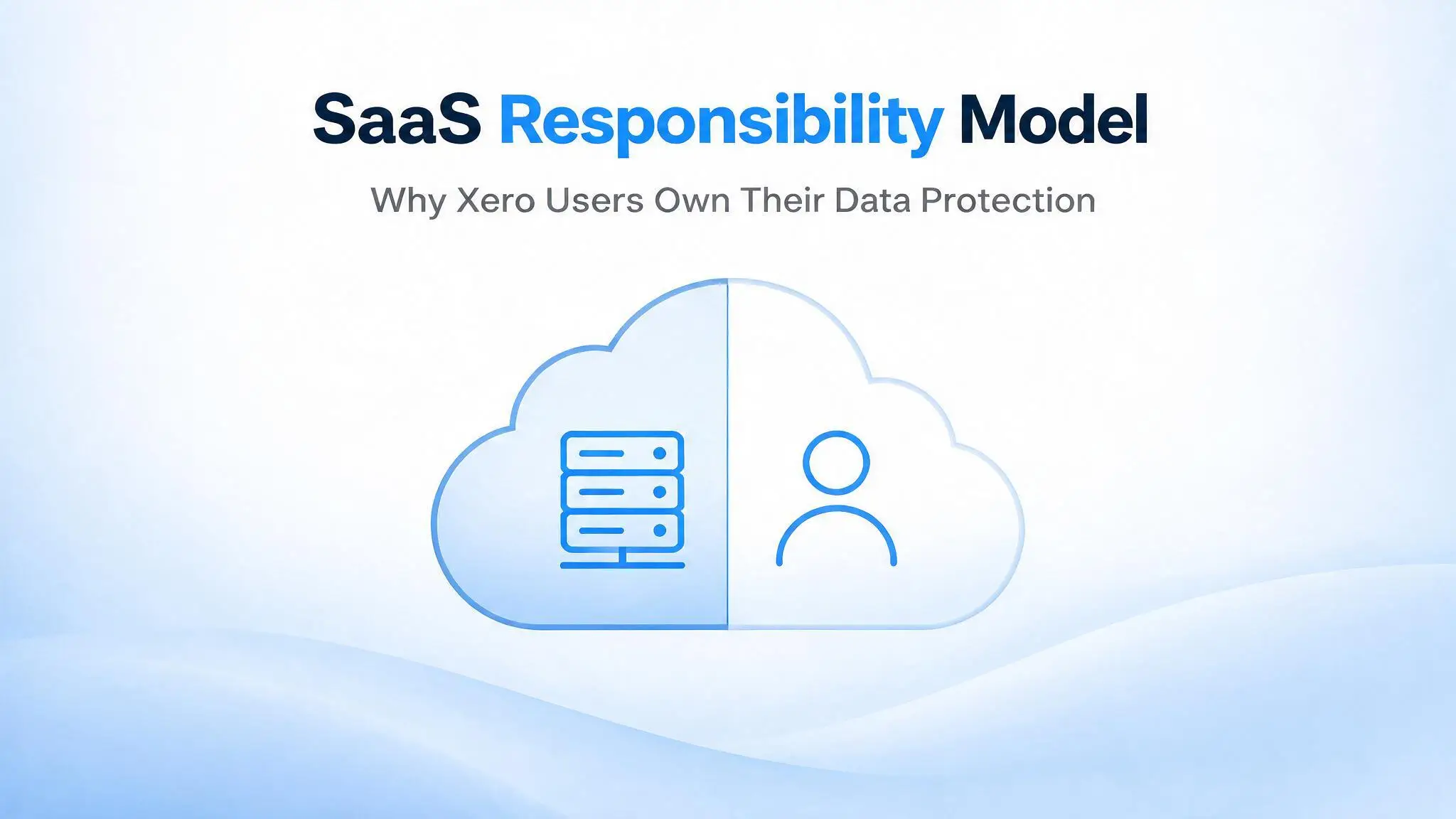
In that model, the provider secures the infrastructure: the physical servers, the network, the application availability, the platform uptime. The customer is responsible for what they put into that infrastructure: their data, their user access controls, their configurations, and their recovery strategy if something goes wrong with their data.
SaaS platforms like Xero inherit this model. Xero maintains the application, the uptime, the security of the platform itself. Your Xero data — your transactions, your contacts, your chart of accounts, your configuration — is yours to protect.
What Xero Is and Is Not Responsible For
Xero's terms of service make the subscriber's data responsibility explicit. Xero is not positioned as a data backup or recovery service. It provides a cloud accounting platform with redundant infrastructure and high availability. If that infrastructure fails, Xero's obligations are clear. But if your data is deleted, overwritten, or corrupted by a user action within your Xero organisation, the responsibility for recovery sits with you.
This is not a criticism of Xero. It reflects a practical and sensible division of responsibility. Xero cannot reasonably be expected to protect every Xero organisation from every possible user action across millions of subscribers. The economics of SaaS do not support that model — and no major SaaS accounting platform takes on that liability.
What it does mean is that the gap between "Xero is running fine" and "our financial data is recoverable" is a gap the subscriber needs to close.
Why the Gap Is Bigger Than Most Users Realise
The Difference Between Platform Reliability and Data Recoverability
Xero's platform uptime is genuinely high. For most users, Xero is simply available — reliably, consistently, without issues. That reliability creates a reasonable sense of security that extends to the data inside the platform. If the platform is never down, it is easy to assume the data is never at risk.
But platform reliability and data recoverability are two different things. Xero being available does not protect your data from what happens inside it. A staff member with admin access can delete a year's worth of contacts. A bulk import with mismatched field mapping can overwrite accounts payable records. A chart of accounts restructure, well-intentioned but undocumented, can silently corrupt months of historical reporting. The platform is up. The data is gone.
Multi-User Environments Amplify the Risk
The same features that make Xero valuable — cloud access, multi-user collaboration, third-party integrations — are the same features that create ongoing data exposure. Every user added to a Xero Organisation is a potential source of unintended changes. Every integration that writes to Xero is a potential source of import errors. Every permission granted at the admin level is a permission that could be exercised incorrectly.
The risk does not decrease over time in a multi-user Xero environment. It compounds. The longer a practice runs on Xero with multiple users and no Xero backup in place, the greater the cumulative exposure to an incident that cannot be reversed without a prior clean backup state.
What Closing the Gap Looks Like in Practice
The Three Questions Every Xero User Should Be Able to Answer
Understanding the SaaS responsibility model leads directly to three practical questions. If you cannot answer all three confidently, the gap is open.
Can you restore a specific prior state of your Xero organisation? Not just some transactions — the complete organisation, including contacts, chart of accounts, tracking categories, bank account settings, and configuration. If your only backup is a collection of CSV exports, the answer is no.
How far back can you go? If an error is discovered three weeks after it occurred — which is the typical timeline for data problems in accounting environments — your backup needs to contain a clean state from before that error. If your backup history only covers the last seven days, you cannot reach it.
Does your backup run without anyone having to remember? Manual export processes fail silently when the person responsible changes roles, gets busy, or simply forgets during a high-pressure period. The answer needs to be yes — automated, consistent, regardless of what else is happening.
How WOW Addresses Each Question
WOW connects to your Xero organisation via the Xero App Store and runs automated nightly Backup Xero snapshots of the complete organisation: transactions, contacts, chart of accounts, tracking categories, bank account settings, and organisation configuration.
Point-in-time restore means you can go back to any prior backup date — not just yesterday's snapshot. When an error is discovered three weeks after it occurred, the clean state from the night before the incident is available. The restore is to the specific date that predates the problem, not the date it was found.
Backup Xero Files coverage runs automatically every night without any staff action required. The answer to all three questions above becomes yes.
At $9.95 USD per organisation per month, Xero Backup Services from WOW close the gap that the SaaS responsibility model leaves open. That is not a product upsell — it is what the responsibility model requires.
A Scenario Worth Considering
Consider a bookkeeping practice that has run on Xero for three years without incident. The platform has never gone down in a way that affected their work. They have no formal backup strategy because, in their experience, Xero has always been there and always been reliable.
A new staff member with admin access, working through a contact list cleanup, accidentally bulk-deletes 200 supplier records across five client organisations. The deletion is discovered three days later when a supplier payment run fails across multiple clients.
Xero's platform is functioning correctly. The data is simply gone from within it. With no backup, the practice spends a week manually reconstructing supplier records from email correspondence, bank statements, and supplier portals — across five clients, under the pressure of outstanding payments.
With WOW running nightly Xero Backup across all client organisations, the practice restores each affected organisation to the backup from two nights before the deletion. Every supplier record is recovered. The payment runs complete by end of day.
The following scenario is illustrative. The access control pattern it describes is routine in multi-user Xero environments.
Conclusion
The SaaS responsibility model is not a flaw in how Xero works. It is a rational division of responsibility between a platform provider and the businesses that use it. Xero's job is to keep the platform running reliably. Your job is to protect the data inside it.
Xero Backup Solutions with WOW are how that job gets done: automated nightly full-organisation backup, point-in-time restore, and coverage that does not depend on anyone remembering to run it. The responsibility is clear. The solution is straightforward.
Start a free trial at wowbackupandrestore.com, or install WOW directly from the Xero App Store. Book an onboarding call and have your data responsibility covered today.